What to Do When a Homeowner Won't Pay a Contractor
When a homeowner or project client does not pay, the first move should be calm documentation. Client Bureau helps contractors organize the invoice, agreement, proof of completion, communication timeline, response context, and next steps before escalation.
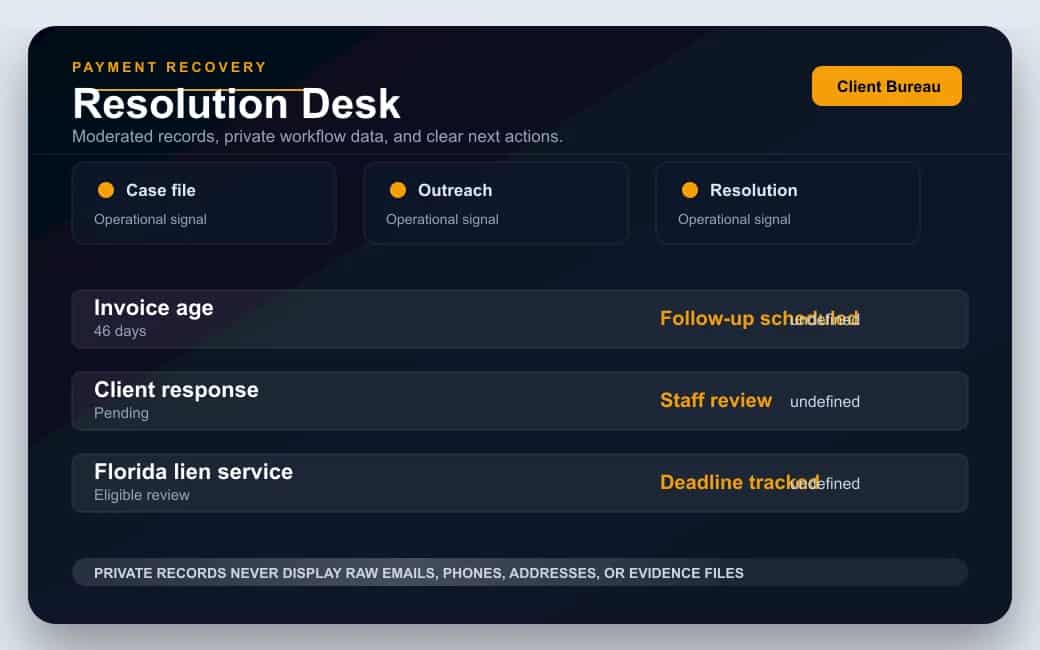
Private workflow
Resolution Desk
Keep the case factual and private while you organize records, request payment, and track response or dispute context.
Before work
Check
Review the relationship before committing labor, materials, scheduling, or deposits.
During work
Document
Keep scope, approvals, evidence, and project records together.
After work
Resolve
Track responses, payment follow-up, and moderated updates.
Privacy
Protected
Private identifiers and raw files stay out of public pages.
When this helps
Use the workflow for a specific business decision.
Keep the case factual and private while you organize records, request payment, and track response or dispute context.
- Final invoice is overdue after completed work.
- Client disputes scope, quality, timing, or amount due.
- You need a clean record before payment recovery, lien review, or attorney/vendor escalation.
Workflow
A clear path from decision to record.
- 1
Collect the signed agreement, invoice, change orders, photos, messages, and completion proof.
- 2
Build a timeline with due dates, reminders, client responses, and any dispute details.
- 3
Send professional follow-up or open a managed Client Bureau Resolution Desk case.
- 4
If the job is in Florida and lien timing matters, create a Florida lien service case for review.
Trust and privacy guardrails
Useful records without public overexposure.
Recovery records, raw evidence, and client contact details stay private.
Client Bureau does not guarantee collection or legal outcome.
Public reporting should remain moderated, factual, and response-aware.
Common questions
Should I make the payment issue public immediately?
No. Start with private documentation, direct communication, and a clear timeline. Public Client Bureau reports are moderated and should be based on documented contractor experiences.
Can Client Bureau contact the client?
For managed recovery cases, Client Bureau can support a private Resolution Desk workflow with factual outreach, logged responses, and resolution tracking.
Does this replace legal advice?
No. Contractors should consult qualified counsel for legal advice, lien enforcement, litigation, or state-specific requirements.
Ready for the next step?
Check the relationship first, then document the work clearly.
Use Client Bureau databases, private Job records, contracts, evidence, and response-aware workflows to make a more informed business decision.